

|
|
Hand und Fuss |
Description of the painting
Alexandra Weidmann has explored the subject of soccer in an extensive series of drawings and paintings. Soccer is ubiquitous in our society and can be examined from many different perspectives. One important aspect is the ability of photography, through the use of fast shutter speeds, to capture scenes from the game and preserve extraordinary compositions of players battling for possession of the ball. Beyond the pleasure of depicting interacting bodies in motion, these images offer an opportunity to explore the concepts of cooperation and competition.
The renowned art historian Horst Bredekamp addressed soccer in his book “Bilder bewegen, von der Kunstkammer zum Endspiel” (Images in Motion: From the Chamber of Art to the Final). The title of its first chapter is “Soccer as the Last Gesamtkunstwerk” – the last comprehensive work of art. Discussing the relationship between soccer and art, Bredekamp writes:
“Because soccer permits physical force but prohibits violence, comparing scenes of warfare with those of this sport is fundamentally misguided. Representations of war and soccer are nevertheless related in that both depict people in states of physical and psychological excitement that cannot be intensified any further. … Images of soccer matches constitute an archive of this extreme experience.”
Comparisons between soccer events and battle or courtroom scenes in the visual arts are therefore readily apparent. Such an undertaking may initially seem blasphemous. Yet in the late nineteenth century, European governments promoted sports such as soccer as a means of improving the physical fitness of young men, with the aim of increasing their fitness for military service. Bredekamp writes:
“In this context, the art and cultural historian Aby Warburg, on one of the final panels of his Mnemosyne Atlas, allowed sequences of images depicting suicide and sacrificial myths to culminate in photographs of athletes – not only without hesitation, but with a clear sense of their inner coherence. This approach applies even more to photographs of soccer players, since they can be regarded as particularly vivid embodiments of competing forces in motion. Numerous scenes from soccer instinctively belong within the history of codified forms of heightened emotion.”
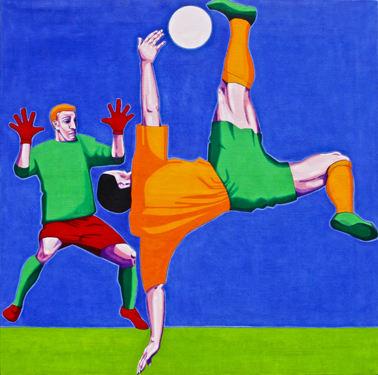
The painting Hand and Foot captures a moment of extreme physical tension during a soccer match. It is the instant before a shot at the opposing goal – the moment toward which all the preceding actions of the game, the attacks and defensive maneuvers of both teams, have been building. An outfield player is about to kick the ball toward the opposing goal, which is defended by the goalkeeper.
The composition is dominated by a player performing a bicycle kick. Suspended in midair, he lies on his back, with his arms extended upward and downward away from his body. One leg is bent, while the other is thrust vertically into the air to strike the ball. The tips of his toes touch the edges of the picture, while his hands do not. The ball, untouched by either player, is positioned precisely between hand and foot, at the center of the upper edge of the pictorial space. The goalkeeper, approximately half the size of the outfield player and identified as such by his red gloves, is pushed toward the left edge of the composition by the other player's body. Only the tip of one foot touches the ground, or the horizon line. Although still connected to the ground, he is about to leap to the left with his hands raised, attempting to prevent the ball – expected to arrive from beyond the picture's edge – from entering the goal. The goal itself is not depicted. The background consists of a blue field and a green field. The relative sizes of the two players provide the only spatial cues.
The outfield player's bicycle kick and the goalkeeper's attempt to save the shot form two related yet opposing figures in motion. While the goalkeeper stretches both hands toward the ball, the outfield player attempts to reach it with his foot. The hands and the foot thus become the decisive actors in the pictorial drama. The title Hand and Foot names not only the body parts involved but also encapsulates, in a concise formula, the opposing actions of defense and attack.
The composition is defined by a radically simplified environment. An intensely blue field occupies almost the entire picture surface; only a narrow green strip along the bottom marks the ground. There are no indications of a stadium, spectators, or the rest of the playing field. The two players and the ball are thereby brought into complete focus. The action appears detached from its spatial and temporal context.
The players and the ball are also outlined by a second, light-blue contour. This makes them look even more like paper dolls intended to be cut out, reinforcing their visual separation from one another. Paper dolls eventually became a toy associated primarily with girls, offering a possible point of connection between the masculine sphere of soccer and the feminine sphere of play.
The vivid colors further intensify this effect. The orange of the outfield player's uniform, the green of the goalkeeper's jersey, and the red of his gloves and shorts stand out sharply against the deep-blue background. Strong outlines and contrasting areas of shading give the bodies a sculptural presence. At the same time, their movements are so dramatically exaggerated that the figures appear to float weightlessly in space.
The ball forms a small, almost perfectly circular point of stillness in the upper part of the painting. The movement of the bodies unfolds around it. The composition freezes the instant at which attack and defense converge, without revealing the outcome of their encounter. The viewer remains suspended between the possibility of a goal and the possibility of a save by the goalkeeper. Everything else – spectators, referee, additional players, and architectural elements – has been erased, as if perceived by a participant whose attention is focused entirely on an event of vital importance.
The depiction in Hand and Foot belongs to a long tradition in the visual arts in which extraordinary bodily postures serve to make movement, exertion, and dramatic tension visible. All of this takes place under the fundamental constraint that a painting contains no time. An image represents either a fleeting instant or eternity, but never a sequence of actions. Since the Renaissance, artists have grappled with the question of how to depict the human body in extreme motion. The challenge has involved not merely anatomical accuracy but also the ability to condense an action into a single pictorial moment.
In Mannerist art, bodies were frequently placed in intricate and exaggerated poses. Figures seem to twist around their own axes, limbs extend in sweeping gestures, and balance is tested to its limits. In the Baroque period, too, extreme bodily postures were used to draw viewers directly into dramatic events. In both cases, the body becomes the vehicle for heightened expressive force. In this respect, Alexandra Weidmann's composition recalls the art-historical tradition of the body in motion.
The soccer players are not depicted in everyday poses but in an acrobatic configuration that transforms each body into a distinct geometric figure. They are arranged so that they do not overlap. They clearly belong to the same meaningful action, yet remain completely isolated from one another. Their outstretched limbs and opposing directions of movement create a tension that goes beyond the straightforward depiction of a sporting event.
Photography provides another important point of reference. Modern sports photography has made visible numerous phases of movement that frequently escape the human eye during the immediate experience of an event. The frozen instant can reveal postures that, outside the photographic image, would scarcely be perceived as part of a continuous movement. The visual arts have adopted these new possibilities while also transforming, intensifying, and reorganizing them into independent compositions.
In Hand and Foot, the moment depicted is recognizable as a specific situation in a soccer match. Yet the arrangement of the figures and their sharply differentiated colors prevent the scene from appearing as a neutral reproduction of a moment captured by a camera. Instead, the soccer match emerges as a carefully constructed pictorial event.
Here, Horst Bredekamp's idea of soccer as an “archive of extreme experience” can be developed further. Soccer concentrates physical exertion, competition, the hope of scoring, and the possibility of failure into a single dramatic instant. The painting does not convey this experience by narrating the entire course of a match. Rather, it deliberately exploits the possibilities of painting by concentrating on a single, unresolved situation. The outcome remains uncertain, and it is precisely this uncertainty that sustains the tension.
Aby Warburg's ideas concerning the afterlife of images and gestures also offer a possible art-historical approach. His study of inherited forms of expression sought to investigate how bodily gestures and patterns of emotional movement recur and change across different historical periods and visual genres. From this perspective, the athletic gesture can be understood as a modern form of bodily expression that connects with older pictorial traditions without being identical to them.
The title Hand and Foot emphasizes the physical immediacy of the scene. The goalkeeper's hands and the outfield player's foot represent the opposing means by which the two athletes attempt to influence the ball. At the same time, the German expression Hand und Fuß haben, literally “to have hand and foot,” ordinarily describes something that makes sense, is sound, or is well thought out. In the context of this painting, the expression takes on a surprising new dimension: here, the mastery of movement in a split second determines success or failure.
By bringing these meanings together, Alexandra Weidmann combines the dynamism of modern sports with a pictorial staging that draws on the tradition of dramatic representations of the human body. Hand and Foot presents soccer not merely as an athletic contest but as a visual event in which movement, tension, and uncertainty about the outcome merge into an independent pictorial composition.