

|
|
Strandgut |
Description of the painting
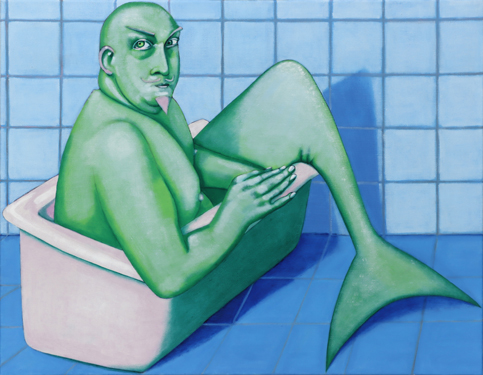
The painting Strandgut (Flotsam) depicts a green-skinned hybrid creature sitting in a tub that is much too small for it, carelessly placed in a tiled room. The human upper body just barely fits, while the long fish tail hangs over the edge of the tub and down onto the blue-tiled floor. With his right hand, he grips the front edge of the tub. His left hand is hidden behind the front section of the tub and remains invisible to the viewer. The creature turns toward the viewer and looks directly at us. The pointed chin beard and upward-twirled mustache suggest that the creature is male. His expression lies somewhere between watchful, questioning, and defiant.
The room could be a bathroom, but it could just as well belong to a slaughterhouse. The overall situation is both absurdly humorous and oppressively sad. The creature calmly and confidently accepts a situation for which it was never made and which leaves it dependent on the help of others. This immediately raises questions about how it ended up in this seemingly hopeless situation and how it might escape from it. What might such a daring attempt at liberation look like? The painting offers no answer. The only clue to a possible interpretation lies in the hybrid creature itself.
Hybrid creatures have been depicted in art for a very long time. What follows is by no means a comprehensive survey. The oldest known example in Europe is the Lion Man in the Ulm Museum, which is approximately 40,000 years old. The history of hybrid creatures thus reaches all the way back to the Paleolithic era. There are also the ancient Egyptian deities depicted as hybrids, such as the goddess Hathor, who appears variously as a woman with a cow's head, a woman with cow's horns, or as a cow herself. Hathor is the goddess of love, beauty, music, dance, joy, fertility, and motherhood.
The world's oldest known depiction of a human-fish hybrid is the god Oannes from Mesopotamian mythology, dating back approximately 4,000 to 5,000 years. This hybrid being is said to have given humanity essential cultural skills, including writing, science, and various arts, as well as the founding of cities and sanctuaries, knowledge of law, and agriculture.
Among the Greeks, a half-human, half-fish being is known as a Triton. As early as the sixth century BCE, Triton appears in Archaic Greek vase painting as a figure with a human upper body and a fish tail.
In more recent times, examples include Disney's 2023 film The Little Mermaid and the presence of merpeople in the Harry Potter series. While hybrid creatures have largely been relegated to children's and young adult entertainment today, in pre-Christian religions they were often highly respected and immensely powerful, or even gods themselves. These beings combined animal and human abilities, transforming them into figures endowed with extraordinary powers.
Alexandra Weidmann thus adopts a visual form with an extraordinarily ancient tradition – but fundamentally changes its meaning. She tells a story of the fall of a myth, of the dismantling of old certainties. It is precisely the combination of a mythological figure with an environment devoted to hygiene and water resistance that creates the painting's peculiar humor. A being that should be at home in the vastness of the sea is forced to make do with a tiny reservoir of water – and even there, its fish body has insufficient room. All the good deeds the creature once bestowed upon humanity could not prevent it from ending up in this hopeless situation. Because no one believes in it anymore and no one accords it any respect, it is condemned to simply vegetate there.
The tiles of the undefined room are particularly significant. Their regular grid represents a human-ordered, controlled, and technologically mastered world. The fish body, by contrast, belongs to an organic, fluid natural world. The two collide in the tub.
Weidmann thus carries an ancient function of the hybrid creature into the present. Hybrid figures cross boundaries: between human and animal, nature and culture, reality and myth, this world and a supernatural realm. The ancient mythological hybrid therefore becomes an image of a present in which the boundaries between nature and the human environment are becoming increasingly problematic. Yet the once-powerful god is anything but threatening. On the contrary, he appears almost serene and slightly amused. It is precisely this lighthearted portrayal that makes the statement so effective without turning the painting into a heavy-handed warning.
Flotsam fits very well into Weidmann's artistic practice of taking familiar cultural and art-historical images and giving them new meaning by placing them in unexpected contemporary situations. Here, the starting point is not a single famous painting, but a visual tradition that has developed over thousands of years: the hybrid creature, and more specifically the fish-tailed Triton.
Weidmann does not attempt a historical reconstruction. Instead, she treats the traditional figure as a kind of cultural fragment and places it within the world of contemporary everyday life. The powerful sea god, ruler of all the world's oceans, becomes an inhabitant of a tub that is far too small – a transformation that also alludes to climate-induced water scarcity. The mythological sea creature ultimately becomes Flotsam.
It is precisely this combination of mythological memory, grotesque humor, and a highly contemporary ecological problem that gives the painting its particular strength.