

|
|
Hasenfreund |
Description of the painting
“The traditional family is becoming a thing of the past in Germany. Instead of a mother, father, and at least two children, people here are now primarily living alone. However, the idea that this group is dominated by young singles is incorrect.” This was written by Der Stern on February 1, 2018. Alternative lifestyles to the traditional family are increasingly accepted in society today. A happy person who lives with his rabbits and feels at ease doing so.
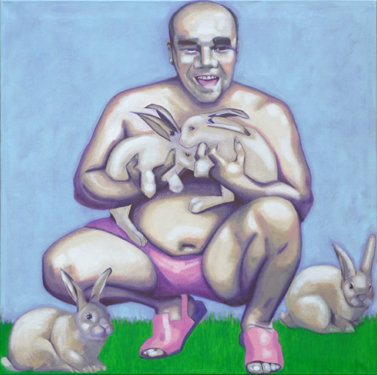
The oil painting “Bunny Lover” by Alexandra Weidmann depicts a solitary male figure in a crouching position against a flat, cool-toned background. The man wears only pink sandals and swim trunks and presses two light-colored rabbits closely against his torso, while two more animals rest calmly at his feet. The depiction is marked by a striking exaggeration: the head appears slightly enlarged, the facial features are emphasized and almost caricature-like, while the body is softly modeled and, without any idealizing smoothing, displays a pronounced fullness. The facial expression remains peculiarly ambivalent – oscillating between joy, detachment, and an elusive indefiniteness.
The color palette subtly reinforces this impression. Cool blues and grays in the background contrast with warm skin tones that lean toward violet. The bright green of the grass creates an almost unsettling accent, while the pink sandals and swim trunks visually highlight the figure and at the same time suggest a deliberate disruption of traditional images of masculinity. It is also striking that the rabbits are rendered more calmly and comparatively more naturalistically than the human figure, creating a peculiar hierarchy of perception: the animals appear almost more stable and “real” than the human himself.
Against the backdrop of changing family structures, the painting can be read as a visualization of an alternative way of life. The rabbits take on a multilayered symbolic function. They stand for closeness, affection, and care, while also serving as substitutes for human relationships. As a traditional symbol of fertility, they are here ironically subverted: in place of classical reproduction, another form of emotional and existential “abundance of life” emerges. The animals thus become a projection surface for intimacy, which is typically located in human relationships.
The depicted figure does not appear lonely in a narrow sense, but rather self-sufficient, inwardly at rest, and emotionally connected – though exclusively in relation to animals. It is precisely here that the painting unfolds its subtle social-critical dimension. It points to a post-traditional lifestyle that is increasingly accepted today without concealing its ambivalences. The happiness shown is difficult to evaluate clearly: it appears at once tender and slightly unsettling, stable and possibly compensatory. The slightly grotesque depiction of the body can be read as an indication that such life models, while part of social reality, continue to be marked as “different.”
From an art-historical perspective, the work operates within a field of tension between portrait and anti-portrait. While classical portraits aim at idealization, this depiction deliberately refuses any smoothing and thus aligns itself with positions of the New Figuration, such as those found in the work of Lucian Freud, in which physicality is rendered unsparingly visible. The relationship between human and animal is also redefined here: unlike traditional animal depictions, which often emphasize detached observation, the painting places intimate, emotional interaction at its center. The painterly approach, which works with subtle irritations in color and proportion, clearly situates the image within contemporary figuration, oscillating between empathy, irony, and critical reflection.
In its overall effect, “Bunny Lover” is far more than an idyllic motif. The painting presents a complex portrait of modern forms of existence and raises the question of what “family” and belonging can mean today. It shows an individual outside classical social structures while leaving open whether this way of life should be understood as a fulfilled alternative or as an expression of subtle isolation. It is precisely this ambiguity that gives the work its particular tension: it is at once tender and unsettling, approachable and distant—and in this, it unfolds a precise and contemplative image of the present.