

|
|
Das Leben, die Arbeit und der Tod, Nr. 2 |
Description of the painting
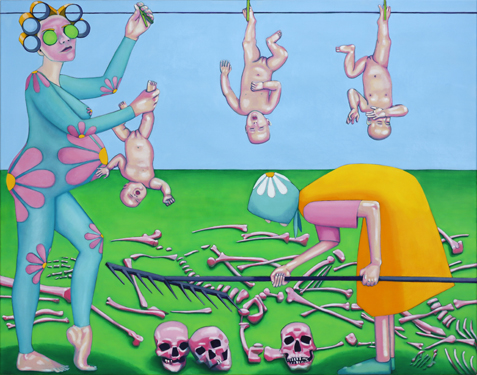
The painting “Life, Work, and Death” depicts various stages of a woman's life in a surreal, symbolically charged visual world. At first glance, the oil painting presents a brightly colored, almost playful scene. Vibrant turquoise, pink, yellow, and green tones initially create a whimsical impression, yet this effect is simultaneously undermined by the work’s stark imagery. It is precisely this contrast between decorative colorfulness and existential severity that forms the painting’s central tension.
In the left section of the composition stands a heavily pregnant woman wearing a tight-fitting, floral-patterned bodysuit. Green cucumber slices cover her eyes, and her hair is set in curlers – classic symbols of female beauty routines and self-optimization. With one foot coquettishly raised, thereby infantilizing herself, she is about to hang a naked female infant upside down from a clothesline stretched across the picture plane, as though it were a piece of laundry. Several other naked female infants are already hanging from the line. In this way, the painting directly links femininity to domestic labor and reproductive work. The children do not appear as beloved individuals but rather as components of an endless cycle of labor.
The central and right foreground continue this idea. Scattered across the green ground lie bones and skulls – the remnants of human life. A stooped elderly woman wearing a headscarf and house apron rakes the bones into a pile as if they were garden waste or fallen leaves. This scene alludes to caregiving and nurturing labor extending beyond death itself: women care for the sick, the elderly, and the dying, and ultimately for the remains left behind by the deceased. The bones may thus be interpreted as symbols of the “invisible” labor of life – the little that remains once everything else has passed away.
The woman becomes, within the painting, the lifelong caretaker of existence itself: Childhood, adulthood, and old age are all devoted to the fundamental maintenance of life, leaving no room for anything else. Domestic labor and reproduction therefore appear not as isolated activities but as an all-encompassing, never-ending mode of existence – or even as the very justification for women’s existence.
From an art-historical perspective, the work can be situated within the tradition of feminist art since the 1960s and 1970s. Artists such as Mierle Laderman Ukeles, Martha Rosler, and Mary Kelly had already addressed the invisibility of women’s reproductive and caregiving labor. Rosler’s explorations of housework and female gender roles in particular find an echo here: the private sphere is rendered politically and socially legible. At the same time, the painting appropriates a subject matter that, for centuries, had been reserved almost exclusively for male protagonists.
The grotesque exaggeration of the bodies also recalls surrealist and neo-figurative visual languages. The upside-down hanging girls appear unsettling and dreamlike, resisting any naturalistic representation. As a result, the work creates a pictorial world situated somewhere between satire, nightmare, and allegory. Its candy-colored palette intensifies this effect: the painting initially disguises its harshness behind a seemingly harmless aesthetic, much as social ideals of femininity romanticize caregiving while obscuring its burdens.
The rake in the foreground also possesses symbolic significance. Traditionally, it is a tool associated with order and cleanliness. Here, however, it becomes an instrument for clearing away human remains. Domestic labor is thus presented as the existential “cleanup work” of life itself – a task that extends from the nursery to the cemetery.
Equally noteworthy is the depersonalization of the figures. The woman with the cucumber slices appears less as a specific individual than as a type or social role. This grants the image a universal dimension: it is not concerned with a single fate but with the structural expectations placed upon womanhood.
Overall, The Life, the Work, and the Death articulates a bitterly ironic critique of the traditional gendered division of labor. The work portrays women’s caregiving labor as a cyclical, lifelong process encompassing physical, emotional, and social work while simultaneously being trivialized by society. The beauty treatment with cucumber slices appears as an additional indignity imposed upon women. In this way, the painting combines humor, grotesque imagery, and social critique into a powerful allegory of women’s lived experience.